WATER MILL PRIMARY SCHOOL 'Anything is Possible'
Physical Education at Water Mill
Water Mill Primary School
Physical Education
Intent
At Water Mill, we recognise the importance of a well-rounded and inspiring P.E. curriculum for a child in primary education. Through physical education, children are able to learn and refine an incredibly wide and diverse range of skills and well as key knowledge to enhance their current and future lives. The intent for Water Mill is to deliver the national curriculum to our pupils in an invigorating and engaging fashion.
P.E. has become more and more relevant in modern society with the increase of higher stress levels and the decrease of physical activity amongst children. By linking our P.E. lessons to the school’s core values of creativity, caring, respect and integrity we are allowing each child to constantly find opportunities to use these values in all other aspects of school life. Alongside this, a strong and exciting curriculum allows the school to promote healthy living not just with diet but with wellbeing and relaxation further equipping our pupils with a strong skillset to use in all other parts of their school/home life. Furthermore, through teaching P.E. the school will increase fair play linking to respect, inclusion of others within team games, strong leadership, good volunteering skills, a positive knowledge of fitness and of course a great sense of excitement when partaking in physical activity. All of these skills taught are all greatly compatible across the whole school curriculum and can be used in lessons from science to reading.
Implementation
At Water Mill, physical education is taught through a range of mediums; we include swimming sessions at the nearby swimming baths, hire an external sports coach for one day a week and make use of our teachers to teach the remaining lessons. We link each lesson to one of the key school values which in turn relate to the British values. We make use of the external sport coaches’ medium term and long-term planning both of which directly link to the national curriculum. The teachers within the school then plan their lessons linked to the current skills being taught that half term. As a result, we have a strong correlation between the lessons taught by the sport coach and the school’s teachers. Through constant and clear communication, the external sport coach is also able to include the theme of work each year group is currently studying within their classroom-based lessons. As a result of all this, each child will be able to:
- Demonstrate inclusivity and tolerance by working with all members of the class
- Show fair play and respect by abiding by the rules of different sports
- Develop leadership skills by verbally communicating with other members of their team/group
- Learn to volunteer and participate in all aspects of any lesson
- Understand the importance of fitness and healthy eating
- Realise the importance of relaxation and mental wellbeing
The children will, every half term, have swimming lessons once a week which will be supplemented by a lesson of P.E. taught by the class teacher. On alternating half terms, the class will receive a lesson taught by the external sport coach along with a class teacher taught lesson. Children will be taught basic agility, balance, coordination skills and helping each other before progressing onto gymnastic and teamwork skill-based lessons. By staggering and building on their learning, this allows the children to fully understand how to use each skill and how to develop them.
Key Concept
The key concepts that are taught and revisited in each year group in P.E are:
|
Body control (including composed movements) |
Children can control their bodies in space: hold stable shapes and balances, manage weight shifts, maintain body tension, land safely, and control posture. Combining individual movements (e.g., balance + travel + roll, or run + dodge + catch) into fluid sequences. Important for gymnastics, dance, multi-skill athletics circuits, and general body-management activities. |
|
Agility |
Ability to travel/run, change direction, accelerate/decelerate, stop/start, and move with control. Vital for invasion games (football, hockey, tag rugby), athletics, and multi-sport games. |
|
Coordination |
Skills to catch, throw, hit, kick or strike using different body parts or equipment (ball, bat, stick, etc.). Important for sports like netball, tennis, hockey, cricket, rounders, tag rugby, football. |
|
Ball skills (including racket/stick skills) |
Sending (throwing, kicking, striking), returning (catching, intercepting, returning), hitting, tracking moving balls, returning under pressure. Used in net/wall games (tennis), field games (cricket, rounders), and invasion/reception games (hockey, netball, football). |
|
Tactical & game-sense skills |
Understanding roles (attacker, defender), making decisions (when to attack, defend, pass, shoot), understanding basic game rules, spatial awareness, using tactics in small-sided or full games. Key for football, hockey, tag rugby, netball, rounders, and other team sports. |
|
Expression & creative movement |
Ability to respond to music or stimuli, move expressively, link movements into sequences, use different levels/directions/speeds, show coordination and control in dance or gymnastic routines. Supports dance units and gymnastics. |
|
Teamwork & problem solving |
Working with partners or small groups to solve tasks, collaborate on group balances or routines, make joint decisions in team games. Critical for team sports (hockey, netball, tag rugby, cricket, rounders), group gymnastics/dance, and cooperative/problem-solving activities. |
|
Physical fitness & athletic fundamentals (run, jump, throw, catch, stamina, strength) |
Basic athletic capacities: running (various speeds/distances), jumping, throwing, endurance, strength, as well as applying them appropriately in games or athletics. Underpins athletics events, games, and supports overall physical literacy. |
|
Personal and social outcomes (including self-evaluation) |
Recognising their own performance, comparing previous and current performance, adjusting technique or strategy, aiming for improvement. Encourages personal progress, resilience, management of emotions, respect, fairness, sportsmanship, and lifelong physical activity habits. |
|
Healthy lifestyles and wellbeing |
Knowing why we warm up/cool down, understanding the impact of activity on the body (e.g., heart rate, breathing), making choices that promote lifelong activity, and safe use of space/equipment. Aiming for independence in leading warm-ups or organising equipment. |
Impact
Children at Water Mill will gain a keen enjoyment of physical activity and clear understanding of how vital fitness and healthy eating is to leading a positive and enjoyable life. They will be able to deploy the skills learnt to all other aspects of school life from lessons to after school clubs. The children will develop socially and emotionally and understand the importance of these alongside that of physical competence. All of these will combine enabling them to become well-rounded and confident individuals with a broad range of transferable skills allowing them to be successful in their future lives
For further information about our Physical Education Curriculum please click on the links below.
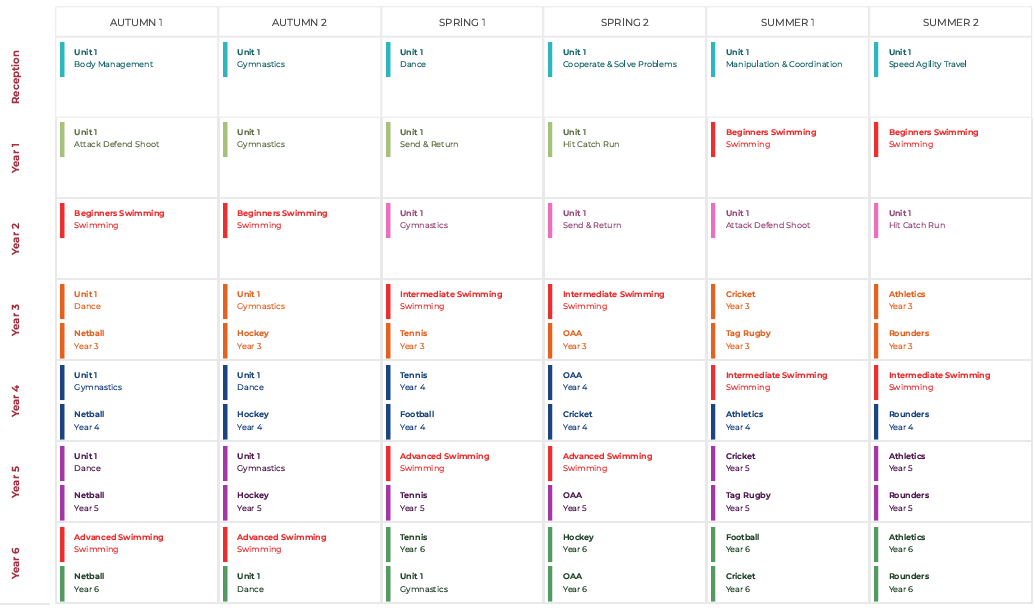
Example Whole School Coverage Plan, subject to change